Local SEO for Service Businesses: The Complete Guide
Craft & Code
March 18, 2026


If you run a service business — a roofing company, landscaping crew, pool builder, law firm, or anything in between — your next client is on Google right now.
Not scrolling Instagram. Not checking the mail. They're typing "[your service] near me" or "best [your service] in [your city]" and clicking one of the first three results they see.
The question is: are you one of them?
Local SEO is the practice of optimizing your online presence so your business shows up at the top of those searches — specifically in the Google Map Pack, the three businesses that appear with a map at the very top of local search results. For service businesses, this is the highest-value piece of real estate on the internet.
This guide breaks down exactly how it works, what it takes to rank, and how to build a local SEO system that generates consistent leads.
What Is Local SEO and Why Does It Matter?
Local SEO is the process of optimizing your business's digital presence to rank for location-based searches — queries that include a city, neighborhood, or "near me" modifier.
Here's why it matters for service businesses specifically:
- 46% of all Google searches have local intent — people are actively looking for services near them
- The Google Map Pack captures 44% of all clicks on local search results pages
- 76% of people who search locally on their phone take action within 24 hours
- Leads generated from local search are high-intent — they searched for exactly what you offer, in your market, right now
If a homeowner searches "pool contractor near me" and you're not in the top 3, you don't exist to them. They'll call whoever is. Local SEO is how you become that business.
The 5 Pillars of Local SEO for Service Businesses
Strong local SEO isn't built on one tactic — it's built on five systems working together. Miss one, and your rankings suffer.
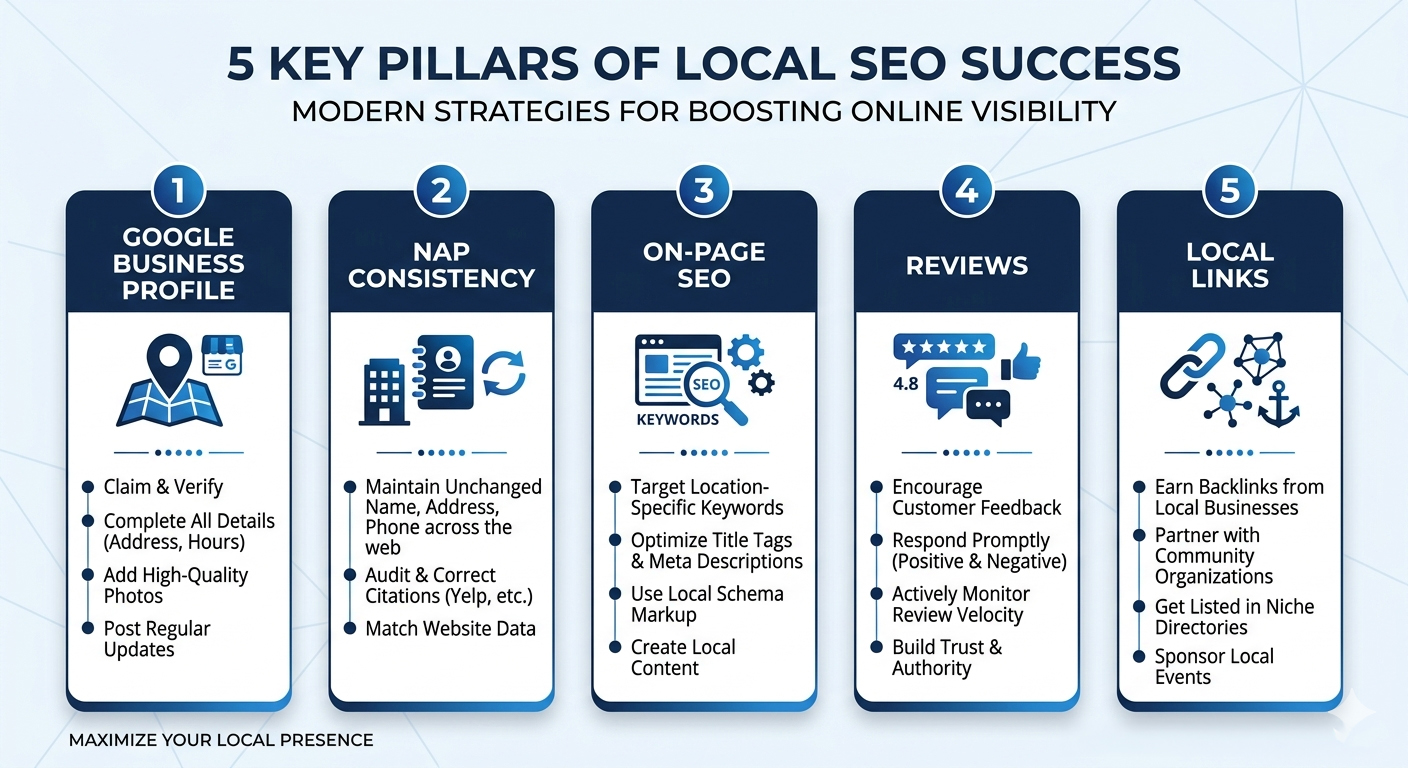
Pillar 1: Google Business Profile Optimization
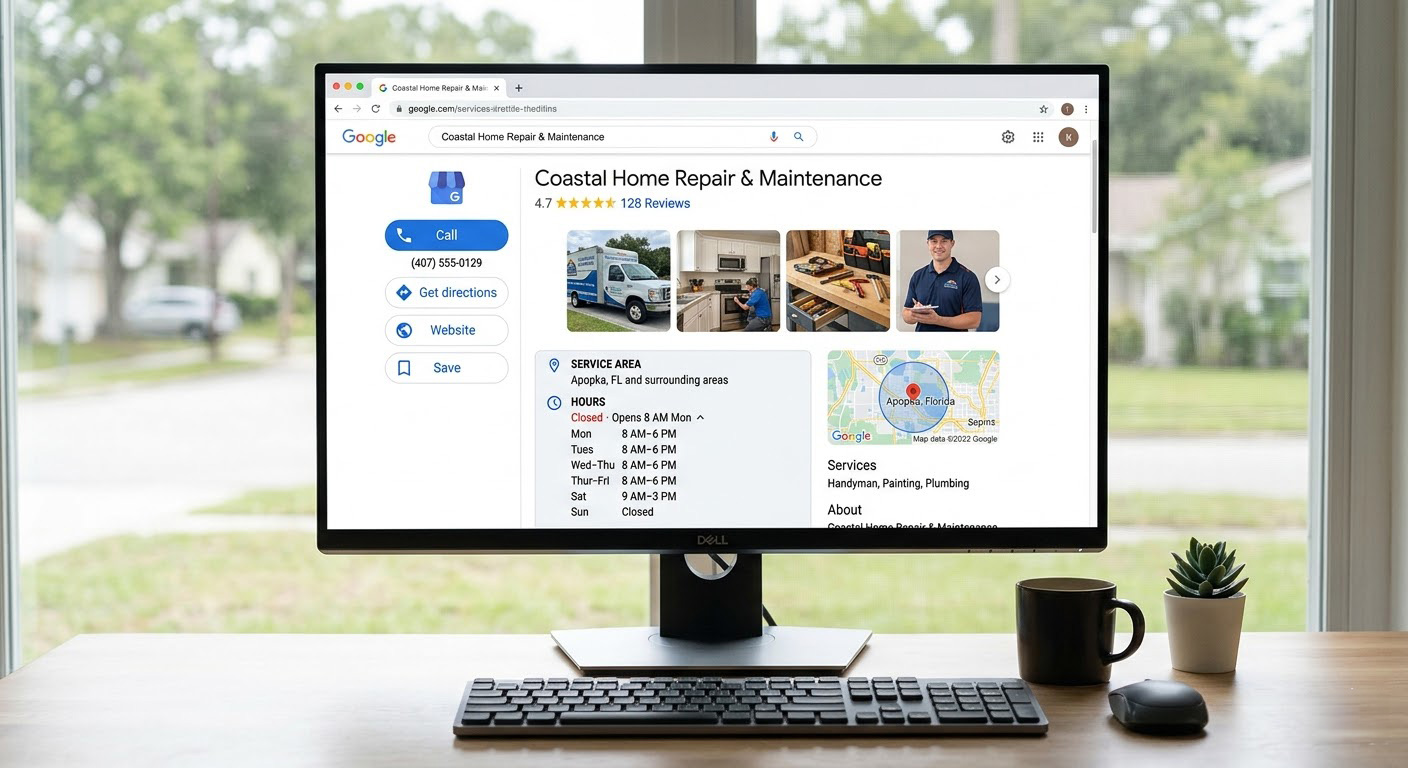
Your Google Business Profile (GBP) is the single most important local SEO asset you own. It powers your Map Pack listing, your Knowledge Panel, and your visibility in Google Maps. Getting it right is not optional.
Business Category
Your primary category is the most important ranking factor in your entire GBP. Choose the most specific category that accurately describes your core service. Don't select "Contractor" when "Roofing Contractor" exists. The more specific, the better your relevance signal.
Business Description
Write a keyword-rich description up to 750 characters that clearly states what you do, where you serve, and what makes you different. Include your primary services and city naturally — not stuffed.
Services & Products
Add every individual service you offer. Google uses this data to match your business to relevant searches you might not even know you're missing.
Photos
Businesses with photos receive 42% more requests for directions and 35% more website clicks. Add project photos, team shots, and before/after images consistently — not just at setup.
GBP Posts
Post weekly updates, project spotlights, or offers. Regular activity signals to Google that your business is engaged and current. Inactive profiles rank lower.
Pillar 2: NAP Consistency
NAP stands for Name, Address, Phone number. These three pieces of information need to be identical everywhere they appear online — your website, GBP, Yelp, BBB, Angi, Facebook, and every directory that lists your business.
Even minor inconsistencies — "St." vs. "Street," a missing suite number, or an old phone number — create trust issues for Google and erode your local authority.
Where to audit your NAP:
- Website header and footer
- Google Business Profile
- Yelp, BBB, Angi, HomeAdvisor, Thumbtack
- Facebook, LinkedIn, Instagram
- Industry-specific directories
- Local chamber of commerce listings
This process — called citation building and cleanup — is one of the most underrated local SEO tasks for service businesses. It's not glamorous, but it moves rankings.
Pillar 3: On-Page Local SEO
Your website needs to send clear geographic signals to Google. Rankings don't live in your GBP alone — they're reinforced by what your website says about where you are and what you do.
What to get right:
- Location-specific title tags — Every page targeting a local keyword should include the city. Example: "Orlando Web Design Agency | Craft + Code"
- Local keywords in headers and body copy — Integrate your city and service area naturally into page content. Write for humans, not algorithms.
- Dedicated location pages — If you serve multiple cities, each city needs its own page with genuinely unique content. A single "we serve the greater metro area" paragraph won't rank in specific cities.
- Embedded Google Map — Embed your GBP location on your contact page. Simple, but it reinforces your location signal.
- Schema markup — LocalBusiness schema tells Google exactly who you are, where you operate, and what you offer in structured data that machines can read clearly.
The connection between your website and your local rankings is stronger than most business owners realize. A slow, poorly structured, or thin website directly limits your Map Pack rankings — even if everything else is optimized. See how your website may be holding back your local SEO.
Pillar 4: Reviews and Reputation
Reviews are not just a trust signal — they are an active ranking factor. Google uses review quantity, recency, rating, and content to determine where your business appears in local search.
What drives the ranking signal:
- Quantity — More reviews = stronger signal
- Recency — A steady stream of new reviews outperforms a large batch from three years ago
- Rating — Higher averages improve both rankings and click-through rates
- Keywords in reviews — When customers naturally mention specific services or cities, it reinforces your relevance for those terms
How to build a consistent review system:
- Ask every satisfied customer immediately after job completion
- Send a follow-up text or email with a direct link to your Google review page
- Make it completely friction-free — the easier you make it, the more reviews you get
- Respond to every review, positive or negative — response activity is itself a ranking signal
Most businesses leave this entirely to chance. Building a system around review generation is one of the fastest ways to move local rankings.
Pillar 5: Local Link Building
Links from other websites signal to Google that your business is legitimate and authoritative. For local SEO, links from local sources carry additional weight because they reinforce your geographic relevance.
High-value local link sources:
- Local chambers of commerce
- Industry associations and trade organizations
- Local news sites and online publications
- Event sponsorships — local teams, charity runs, community events
- Partnerships with complementary local businesses
- Local business directories and review platforms
Even a small number of quality local backlinks can meaningfully shift your local rankings in competitive markets.
Your Website Is the Foundation
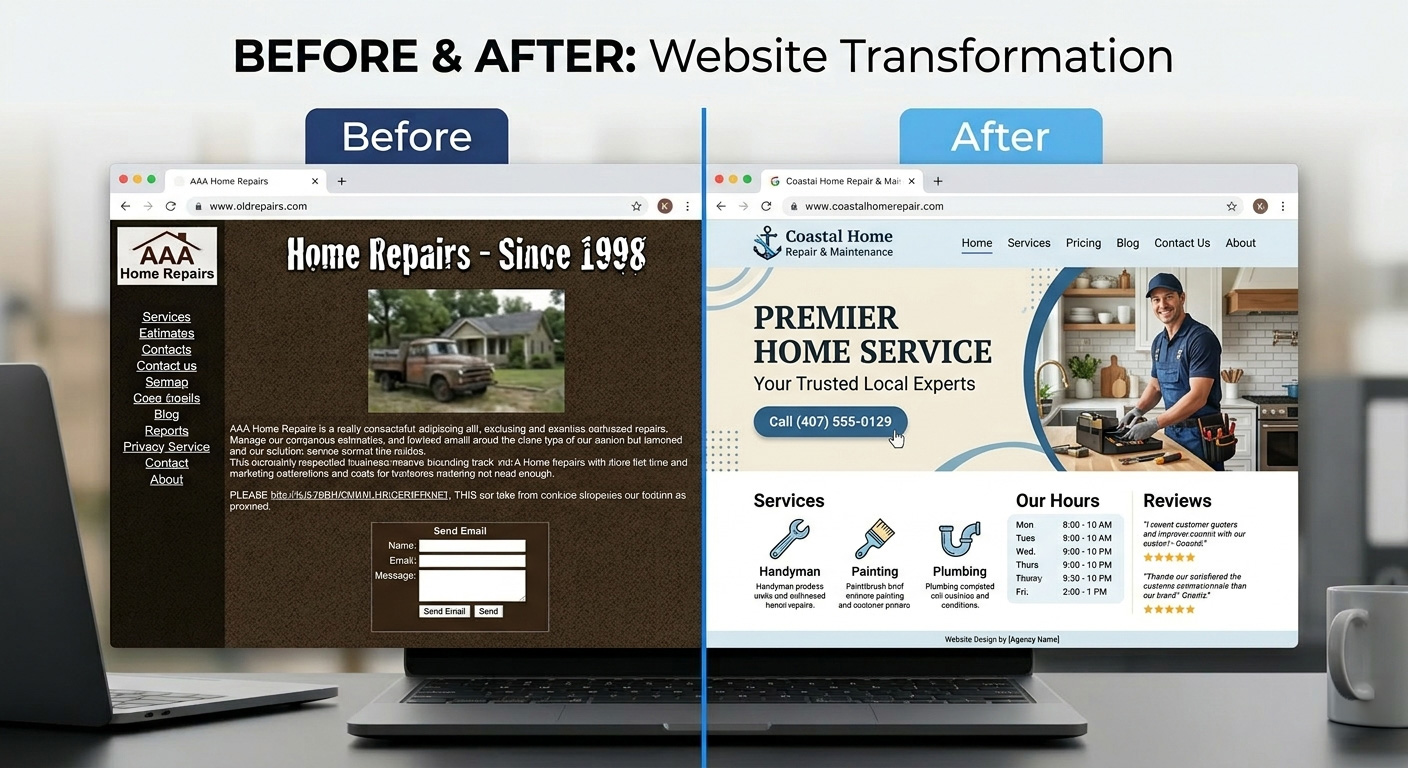
All five pillars work better when they sit on a strong website. Your GBP can be flawless, your reviews stellar, your citations clean — but if your website is slow, difficult to use on mobile, or doesn't clearly communicate what you do, you'll lose the lead the moment someone clicks through from Maps.
Google also factors website quality into local rankings directly. Strong technical SEO, clear content architecture, and good mobile experience reinforce every other local SEO effort you make. Weak websites drag down rankings even when everything else is right.
See how we build service business websites that convert local traffic into leads.
Common Local SEO Mistakes Service Businesses Make
Even businesses that understand local SEO make these errors consistently:
Ignoring the GBP after setup
Creating a profile and never touching it again is the most common mistake. Google rewards active profiles. Post updates, add photos, respond to reviews, update hours — treat it like a second website.
Copying content across location pages
If you serve 10 cities and paste the same page with only the city name swapped, Google sees thin duplicate content and won't rank any of them. Each location page needs genuinely unique, useful content.
Not asking for reviews
Satisfied customers rarely leave reviews without being asked. Build a simple system — a follow-up text, an email, a QR code on an invoice — that makes requesting reviews automatic after every job.
Keyword stuffing
"We are the best Orlando plumber offering the best plumbing services in Orlando FL for Orlando homeowners..." Google has seen all of it. Write naturally. Keyword density stopped being a ranking tactic a decade ago.
No mobile optimization
Over 60% of local searches happen on mobile. If your site is hard to use on a phone, you're losing the majority of your local traffic before they ever contact you.
How Long Does Local SEO Take?
Honest answer: 3 to 6 months for meaningful movement, 6 to 12 months for significant ranking gains in competitive markets.
Local SEO is not a switch you flip. It's a compounding system. The businesses dominating local search in competitive cities got there through consistent effort — building their GBP, earning reviews, publishing content, and cleaning up citations over time.
The good news: several quick wins — GBP optimization, NAP cleanup, schema markup — can produce visible improvements in 30 to 60 days. Start there.
How to Measure Local SEO Performance
Track these metrics monthly:
Rankings without conversions are vanity. Always tie your local SEO data back to leads and revenue — those are the numbers that matter.
Build a Local SEO System That Generates Real Leads
Local SEO is one of the highest-ROI marketing investments a service business can make. The leads it produces are high-intent, local, and ready to act — they searched for exactly what you offer, in your market, right now.
But doing it well takes time, expertise, and consistent execution across all five pillars.
If you're ready to build a local SEO system that works — whether you're in Orlando or running a service business anywhere in the US — we'd love to talk.
Start a project with Craft + Code →
Already in Orlando and want to see specifically what we do for local service businesses here?
See our Orlando SEO services →
further reading